
AI didn’t make design faster. It moved where design happens.
Generation is cheap now. Producing options is easier than evaluating them and agreeing on a direction.
The design artifact has become a team interface
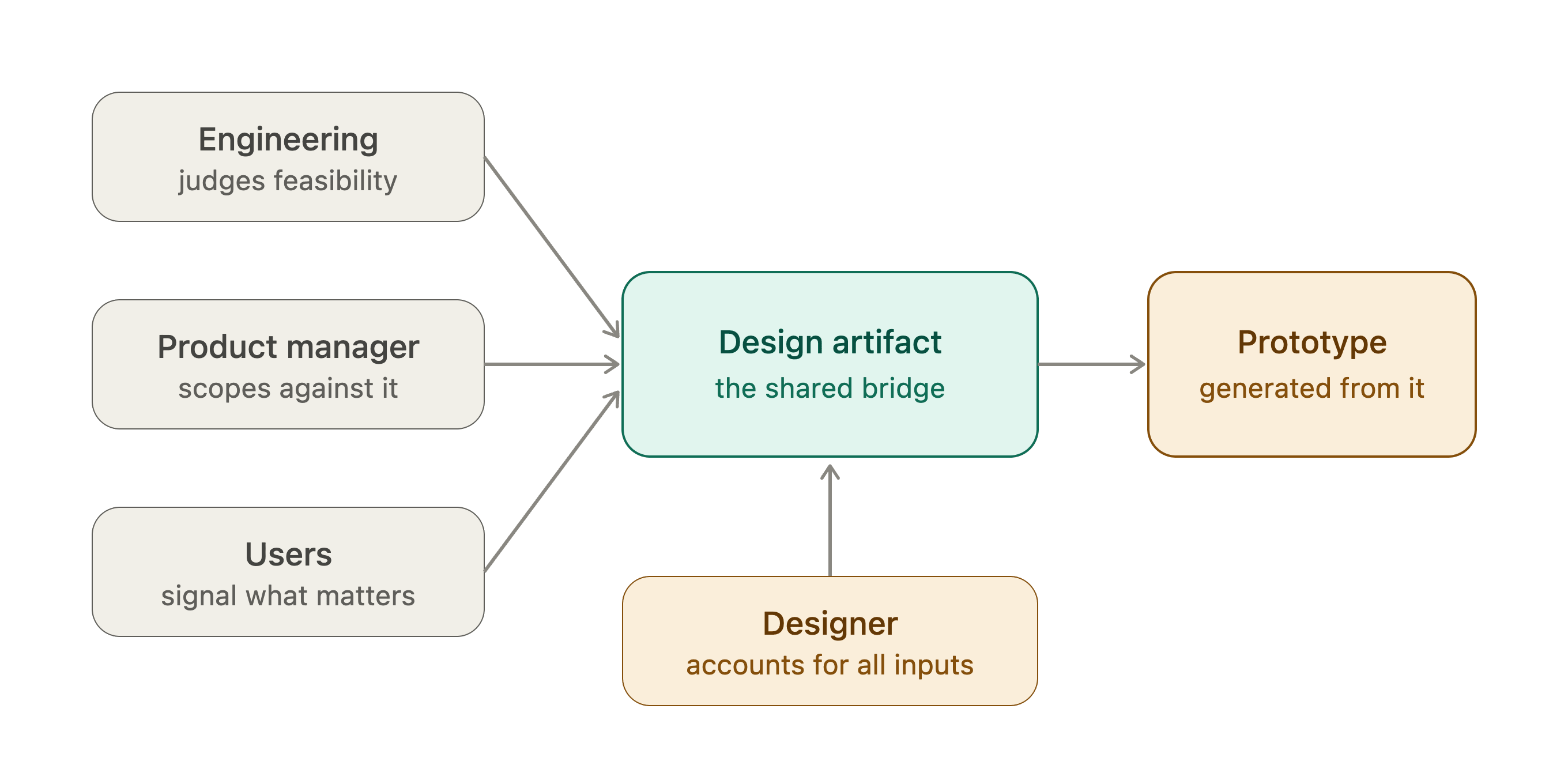
Ask what early-stage design produces, and the familiar answer is a set of design artifacts: flows, wireframes, screens, and eventually a clickable mock. For most of the discipline’s history, those artifacts lived inside the design team. Engineering saw them at handoff reviews, the PM saw them in decks, and users saw them, at best, in a moderated test.
A generated prototype travels further. Engineering can inspect it, product managers and clients can scope against it, and users can interact with it earlier. On its own, it does not answer questions of feasibility, scope, or value, but it gives the whole team something more concrete to react to.
That shift does not make design expertise less necessary. It makes the quality of the artifact and the judgment behind it more consequential. As prototypes take on a larger role in product conversations, designers are still needed to decide what to make visible, what to leave unresolved, and what the team should respond to.
AI makes producing options fast; deciding between them is still the designer’s job
Four things are dramatically easier than they were two years ago:
- You can produce several high-fidelity directions in an afternoon instead of one in a week.
- You can construct and evolve a serviceable design system as a foundation.
- You can ask a model to critique a design and get a useful list of feedback in minutes.
- You can convert work between formats, a sketch into frames, frames into working code, in a fraction of the time they used to take.
All four of these multiply options, but none of them makes choosing between options easier. Ten polished directions still need one person to say which two are worth pursuing and why. A generated design system still needs someone to decide what it should enforce and where it should stay flexible. An AI critique still needs someone to judge which of its twelve flags actually matter for this product. In each case, the bottleneck moves from producing options to evaluating them.
The judgment ladder
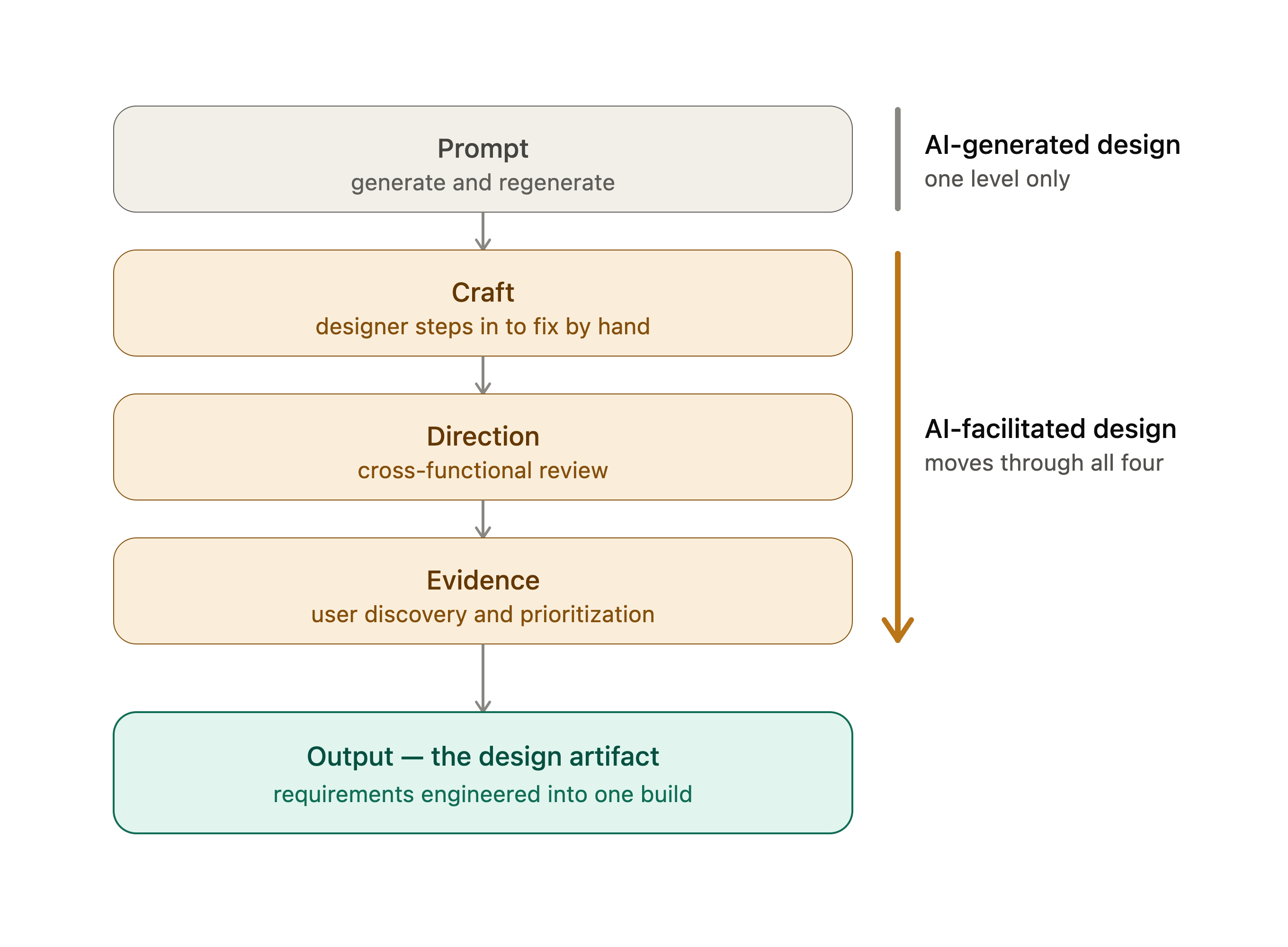
If choosing is the work, it helps to see that not all choices happen at the same level. The judgment ladder has four rungs, and moving down them means stepping further outside the generation loop.
- The first is the prompt: describing what you want and regenerating until it appears.
- Next is craft: seeing that the spacing on a generated screen has drifted, and fixing it by hand in thirty seconds rather than spending ten minutes steering the agent toward it.
- Below that is direction: recognizing that a flow does not need another variant, it needs restructuring, or deciding that a visual scheme is settled enough to commit to.
- At the bottom is evidence: judging when internal iteration has stopped producing new information, and pausing the generation loop to get real user signals instead.
One failure mode is to treat prompting as the whole design process. In that mode, everything happens through the prompt: the fixes, the direction changes, the calls about when something is done. There is nothing wrong with spending time on the first rung; everyone using these tools does. The risk is being unable to leave it. When the prompt will not produce the fix, the work needs someone who can take over the cursor. When the tenth variant still feels wrong, it needs someone willing to say the flow itself is the problem. When the team is confidently iterating on an assumption, it needs someone with the standing to say it is time to put the thing in front of users.
A designer who can move between all four rungs is doing something the tools cannot do at any of them.
Early prototypes make feasibility conversations more concrete
Good designers have never worked in isolation, and feasibility conversations with engineering have always happened early on healthy teams. What has changed is what those conversations have to work with.
- Around a static frame, an engineer has to imagine the implementation and estimate from experience.
- Around a rough clickable prototype in a real frontend, they can point at specifics: this interaction is cheap, that one pulls in a dependency, this screen assumes data that lives somewhere else.
And the same logic applies to conversations with product leaders and users. The compromises can now be named earlier and more concretely, when it is still inexpensive to change course.
The timing matters too. The prototype becomes useful to the team before it feels finished, and recognizing that point is part of the designer’s judgment. Another round of polish may add less than an early conversation about feasibility.
Takeaways
Part of the design workflow has meaningfully become cheaper. The ability to produce polished screens quickly, while still valuable, is no longer as differentiating as it once was. What separates teams now is the methodology around the tools: an AI-native way of working that defines where generation is trusted, where a human takes over the cursor, when a flow gets restructured, and when internal iteration stops and user evidence is gathered.
A few takeaways from how this plays out in MVP work:
- For designers: own the judgment. The decisions that matter most are which direction to pursue, when to fix a screen by hand instead of prompting again, and when to stop iterating internally and seek user evidence.
- For product and business leaders: align on an AI-native, designer-driven methodology before the product direction is settled, not after. Faster production of high-fidelity artifacts lets design take on scoping and feasibility work earlier, but the value of the phase comes from the decisions it resolves, not the number of screens it generates.
- For teams: incorporate functional and engineering expertise into the design process early, while prototypes are still rough. That is when scope and feasibility compromises are cheapest to address, and it is what makes the eventual product more robust and scalable.
One more observation follows from all of this: the higher the rung, the less a designer works alone. Direction and evidence calls are shared, and they are shared with the product manager more than with anyone else. How a designer and a PM divide, contest, and hand off these judgments is the subject of the next post in this series.